
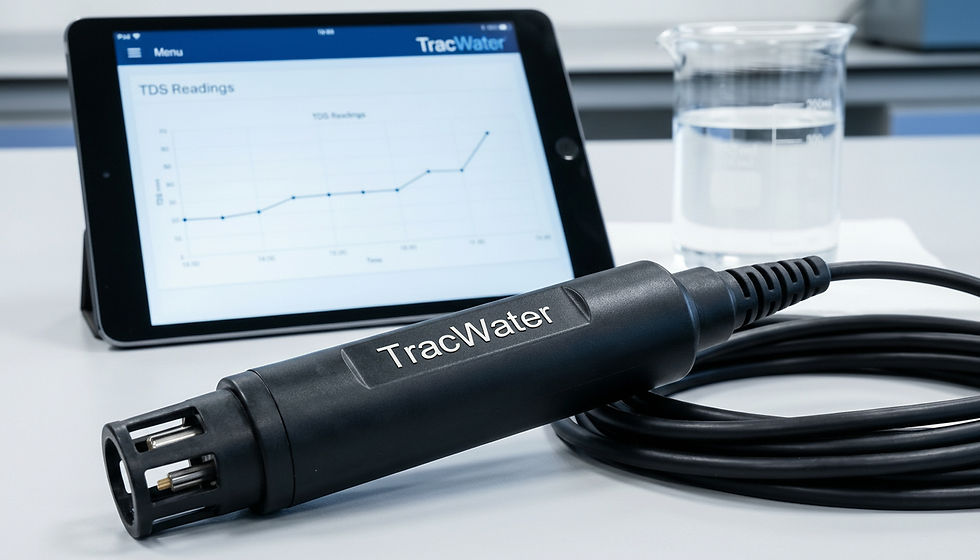
Algae Sensors
‘Product image is for illustration purposes only, the actual product may vary.’
Specifications
Name: TracWater Self-cleaning Chlorophyll Sensor
Model: TW-4728A
Measuring principle: Fluorescence method
Range: 0-500μg/L
Accuracy: ±5% or 0.5μg/L (take the bigger one)
Size: Φ36mm*198.2mm
Note: Please contact TracWater to get a copy of the full sensor specifications.
TracWater Self-cleaning Chlorophyll Sensor
Model number:
TW-4728A
Product description:
TracWater TW-4728A Self-cleaning Chlorophyll Sensor utilises advanced optical technology. The sensor is equipped with an automatic cleaning brush and a compact integrated design, efficient power management, sturdy structure, stable sensor performance, and requires minimal maintenance and calibration. Additionally, the chlorophyll meter can be used continuously online for extended periods.
Overview
TracWater TW-4728A digital chlorophyll sensor integrates advanced optical technology. Equipped with an automatic cleaning brush and a compact integrated design, it provides efficient power management and robust construction. Featuring stable sensor performance, it requires minimal maintenance and no recalibration, making it ideal for long-term online monitoring. It is extensively applied in the monitoring, research, and investigation of algae and phytoplankton in diverse environments, including rivers, lakes, ponds, marine surveys, aquaculture, and drinking water sources.
Features
Digital sensor with RS-485 output and MODBUS protocol support.
Utilises advanced fluorescence sensing technology for accurate and reliable measurements.
Employs a sapphire material optical structure, ensuring consistent and stable performance.
Includes a self-cleaning brush to prevent microbial attachment and extend the maintenance interval.
All calibration data is stored directly in the sensor, enabling on-site installation and immediate use.
Applications
Water Quality Monitoring: Monitoring lakes and reservoirs for algal blooms and overall water quality. Tracking the health of rivers, streams and other freshwater ecosystems.
Coastal Water Monitoring: Assessing the impact of nutrient loading and monitoring marine ecosystems.
Agriculture: Monitoring chlorophyll levels in crops to optimise fertilisation and irrigation. Carry out plant health assessments by detecting plant stress and nutrient deficiencies.
Environmental Research: Ecological studies researching the dynamics of phytoplankton populations and primary productivity. Climate change studies to monitor the impact of climate change on plant and algae growth.
