
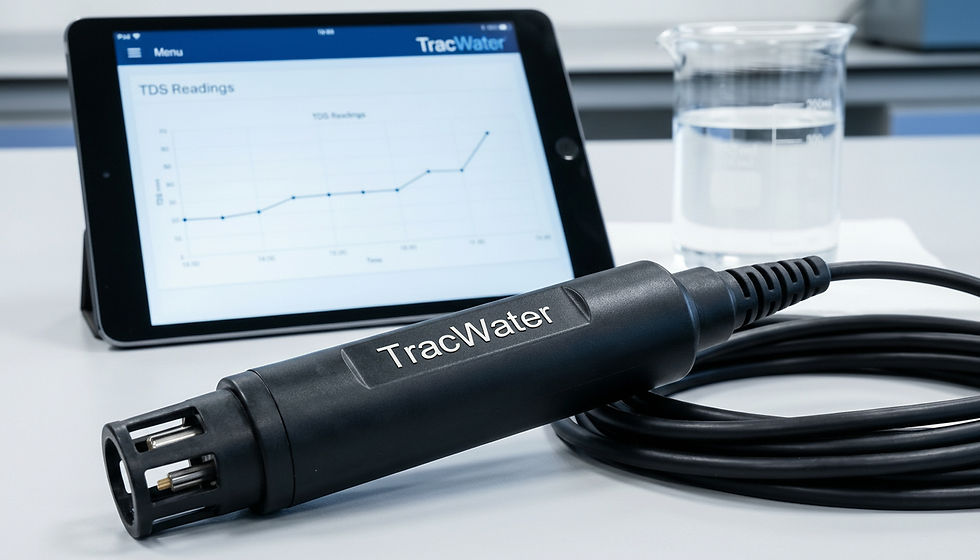
Algae Sensors
‘Product image is for illustration purposes only, the actual product may vary.’
Specifications
Name: TracWater Online Chlorophyll Sensor
Model: TW-4729A
Measuring principle: Fluorescence method
Range: 0-500μg/L
Accuracy: ±5% or 0.5μg/L (take the bigger one)
Size: Φ22mm*175.5mm
Note: Please contact TracWater to get a copy of the full sensor specifications.
TracWater Online Chlorophyll Sensor
Model number:
TW-4729A
Product description:
TracWater TW-4729A Online Chlorophyll Sensor adopts fluorescence method measuring principle. It is widely used in the monitoring, investigation and research of algae and phytoplankton conditions in rivers, lakes, ponds, marine surveys, aquaculture, drinking water sources and other scenes.
Overview
TracWater TW-4729A Online Chlorophyll Sensor adopts the fluorescence method to measure chlorophyll a concentration in water. By leveraging the spectral absorption characteristics of chlorophyll a, it emits high-energy LED light to excite chlorophyll molecules, which subsequently emit fluorescence at a specific wavelength. Its compact and lightweight design renders it highly suitable for field applications.
Features
Digital sensor with RS-485 output and MODBUS protocol support.
Requires no electrolyte, exhibits strong resistance to interference, and eliminates the need for frequent calibration.
Utilises advanced fluorescence sensing technology for precise measurements.
Incorporates a sapphire material optical structure, ensuring stable performance under various conditions.
All calibration data is stored directly in the sensor, enabling on-site installation and immediate use.
Applications
Surface Water Monitoring: Monitoring lakes and reservoirs for algal blooms and overall water quality. Tracking the health of freshwater ecosystems (rivers and streams, etc.).
Drinking Water Safety: Source water monitoring to ensure the quality of raw water in reservoirs and treatment plants. Distribution networks monitoring of water quality throughout the supply network to prevent contamination.
Aquaculture: Monitoring water quality of fish farms to ensure the health and productivity of aquaculture operations.
Environmental Research: Ecological studies researching the dynamics of phytoplankton populations and primary productivity.
