
What Is Water Quality Monitoring?
A clear water sample can still hide a treatment upset, a contamination event or a slow-moving network issue. That is why the question what is water quality monitoring matters well beyond the laboratory. For utilities, councils, industrial operators and environmental managers, it is the discipline of continuously measuring the condition of water so decisions can be made faster, with less guesswork and far more operational control.
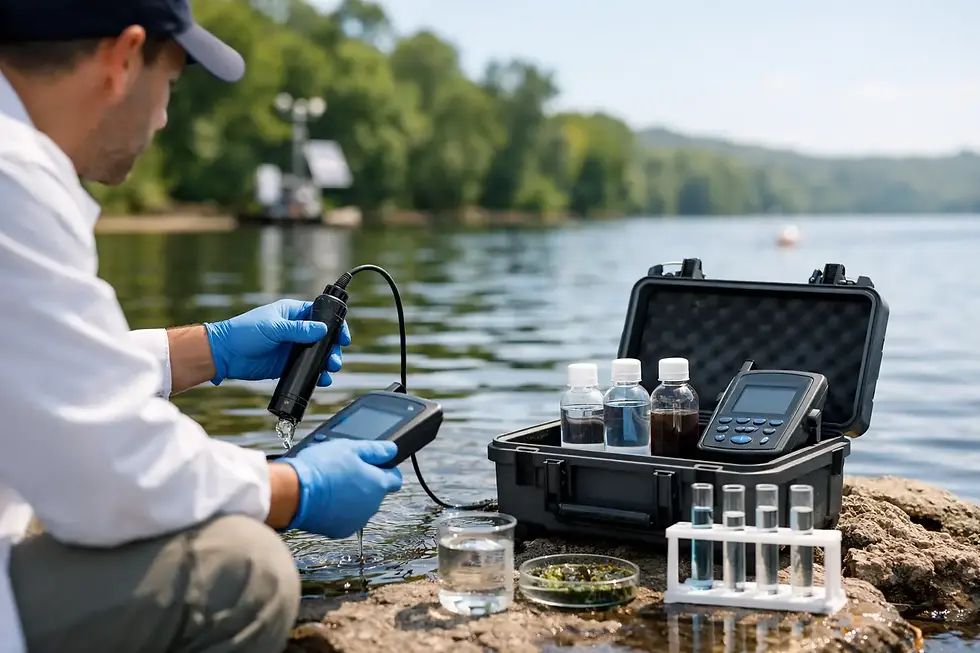
Water quality monitoring is the process of measuring physical, chemical and biological indicators in water to understand whether it is fit for its intended use, whether conditions are changing, and whether intervention is required. In practice, that can mean checking treated drinking water in a distribution network, tracking wastewater process performance, monitoring trade waste discharge, or observing environmental waterways for emerging risk.
For infrastructure operators, the key point is this: monitoring is not just about collecting readings. It is about generating reliable, time-based intelligence from distributed assets so teams can detect change early, verify compliance, protect public health and optimise operations.
What is water quality monitoring in operational terms?
In operational terms, water quality monitoring is the measurement system wrapped around a water asset or network. It combines sensors, analysers, communications, power, data handling and visualisation into a single information chain. The output is not a spreadsheet of isolated results. It is a live picture of system behaviour.
That distinction matters. A grab sample taken once a week might confirm whether a parameter was acceptable at one moment in time. A real-time monitoring system shows trend movement, event duration, rate of change and site-to-site variation. For network managers and treatment teams, that difference can be the line between proactive intervention and delayed response.
The exact configuration depends on the application. A drinking water network may focus on chlorine residual, pH, turbidity, conductivity and temperature. A wastewater or trade waste site may prioritise dissolved oxygen, ammonium, ORP, pH, conductivity and flow-linked quality data. Environmental programs may require dissolved oxygen, blue-green algae indicators, salinity, level and multiparameter profiling. The principle is the same across all of them: continuous or scheduled measurement that informs action.
The parameters that define water condition
Water quality is never described by one number. It is assessed through a set of parameters that together indicate whether the water is stable, compliant and suitable for use.
Physical parameters include turbidity, temperature, colour and suspended solids. These often give early clues about changes in source water, sediment movement, process performance or intrusion. Chemical parameters include pH, conductivity, chlorine, dissolved oxygen, ammonium, nitrate and ORP. These are central to treatment control, corrosion risk, disinfection performance and process stability. Biological indicators can include algae-related measurements, microbial proxies or lab-based testing for pathogens and contamination.
The right parameter set always depends on the asset and the risk profile. A bore field, recycled water scheme, sewer network and potable distribution DMA do not need the same instrumentation. Over-monitoring can add cost and complexity. Under-monitoring can leave critical blind spots. Good system design starts with the operational question being asked, not just the sensor catalogue.
Why continuous monitoring has become the standard
Manual sampling still has a role, particularly for compliance verification and detailed laboratory analysis. But on its own, it is limited. Water systems do not change on a neat inspection schedule. Pressure transients, contamination ingress, treatment drift, storm impacts and industrial discharge events can occur between site visits.
Continuous monitoring closes that visibility gap. It allows operators to see trends in real time, trigger alarms on threshold exceedance and compare network behaviour across multiple sites. This is especially valuable in large and distributed systems where sending crews to every location is neither efficient nor economical.
There is also a labour and safety advantage. Remote monitoring reduces unnecessary field attendance, limits exposure at difficult sites and allows maintenance to be based on asset condition rather than routine alone. For councils and utilities managing broad catchments or remote assets, that is not just convenient. It improves resilience.
How a modern monitoring system works
A modern water quality monitoring system typically begins with field instrumentation. This may be a single sensor, a multi-parameter sonde, or a robotic analyser designed for higher-frequency and application-specific measurement. The hardware is installed in a fixed cabinet, portable enclosure, in-ground chamber, buoy, pipe network, treatment site or remote environmental location.
The instruments capture data at a defined interval. That data is then transmitted through wireless communications to a secure cloud platform or supervisory system. From there, users can view live readings, trend graphs, alarm states, site maps and historical reports. If the deployment is well designed, the system also supports integration into SCADA, modelling environments or broader asset intelligence frameworks.
The most effective systems are plug-and-play from an operational standpoint. They do the field measurement, communications, data delivery and visualisation as one coordinated solution. That removes a common barrier for asset owners: piecing together separate hardware, telemetry, software and IT infrastructure just to make monitoring work at scale.
Where water quality monitoring delivers the most value
Potable water networks are an obvious example. Real-time quality data helps utilities track disinfectant residuals, detect anomalies in distribution zones and verify that water quality remains stable from treatment plant to customer connection. In DMA-based programs, quality monitoring can sit alongside flow and pressure data to build a far more complete network picture.
Wastewater systems use monitoring to improve process control, reduce compliance risk and detect influent or discharge changes before they become plant-wide problems. In sewerage and trade waste environments, upstream monitoring can identify abnormal loading, industrial discharge impacts or corrosive conditions.
Environmental water applications are different again. Here, the value is often in understanding seasonal change, storm response, stratification, oxygen collapse or nutrient-related deterioration across rivers, lakes, wetlands and storage assets. The challenge in these settings is often power, communications and site accessibility, which makes low-maintenance remote systems particularly important.
Industrial facilities tend to focus on operational certainty. They need to know whether process water, cooling water, discharge water or trade waste streams remain within target. Monitoring helps reduce manual effort while supporting compliance and protecting downstream infrastructure.
The trade-offs that matter in system design
Not every monitoring project needs the same level of instrumentation, speed or analytical complexity. Some sites need high-speed event capture because short-duration excursions matter. Others need stable long-term trend data with low maintenance demand. Some applications can rely on compact sensor deployments, while others justify analyser-based systems for greater specificity or automation.
There is always a balance between capital cost, maintenance profile, accuracy requirements and operational risk. Optical and amperometric sensors, for example, each suit different duties. Portable units offer flexibility, but fixed installations often provide better continuity. Solar-powered remote units expand deployment range, but site energy budget and communication conditions still need proper engineering.
This is why water quality monitoring should be treated as infrastructure design, not just instrument procurement. The quality of the outcome depends on how well the sensing technology, site conditions, telemetry path, cleaning regime, calibration approach and data workflows have been matched.
Data only matters if it drives action
One of the most common failures in monitoring programs is not poor sensing. It is poor data use. Operators can be flooded with readings but still lack decision-ready insight if alarms are poorly configured, trends are not contextualised, or field assets are not geo-mapped in a usable way.
Effective monitoring systems convert raw data into action. That may mean immediate alarm notification when chlorine residual drops below target, automated escalation when turbidity rises rapidly, or long-range trend analysis that supports master planning and renewal decisions. Historical datasets also become more valuable over time, especially when they can be compared against rainfall, flow, pressure, production changes or known operational events.
For technically informed buyers, this is where system architecture matters. A sensor on its own is not a monitoring strategy. The real value comes from complete, field-proven infrastructure that captures the data reliably, transmits it securely and presents it in a form that operations teams can trust.
What is water quality monitoring really for?
At its core, water quality monitoring exists to reduce uncertainty. It helps operators see what is happening across assets they cannot stand beside all day. It supports compliance, but that is only one part of the picture. It also protects service levels, reduces manual effort, shortens response time and gives engineering teams the evidence they need to make defensible operational decisions.
For organisations managing distributed networks, the shift is significant. Monitoring is no longer a periodic checking exercise. It is becoming a live operational layer across water, wastewater, stormwater and environmental systems. That shift is exactly why utility-grade, real-time platforms have moved from optional technology to practical network infrastructure.
If the goal is better control, earlier detection and stronger confidence in network performance, water quality monitoring is not simply about measuring water. It is about measuring the condition of the system that delivers, treats or receives it.


Comments