
A Guide to Residual Chlorine Measurement
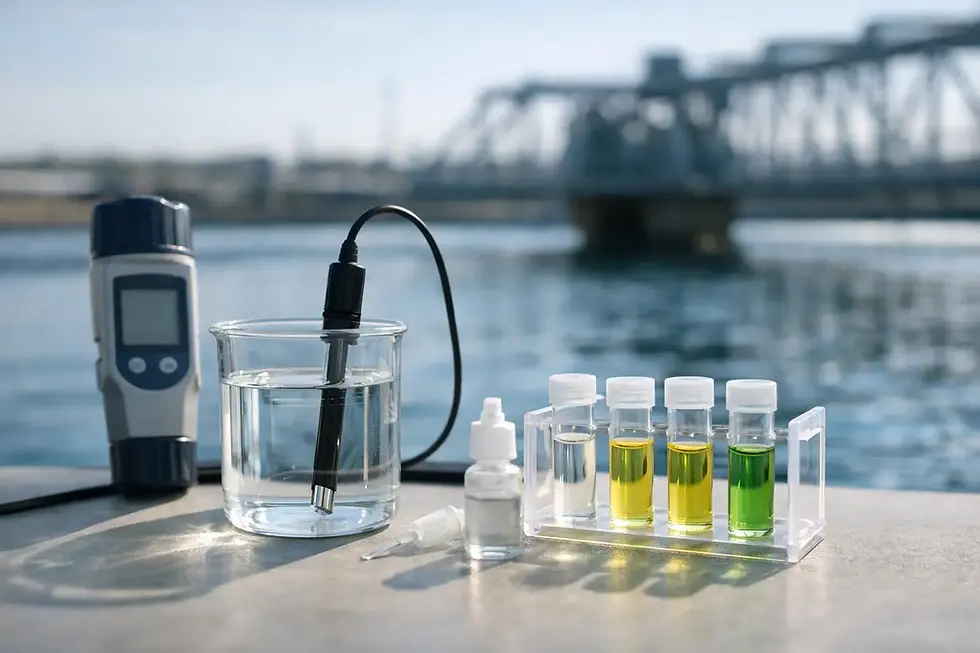
A chlorine residual of 0.8 mg/L at the treatment plant can become a customer complaint, a compliance risk or an operational blind spot by the time water reaches the far end of a reticulation network. This guide to residual chlorine measurement explains how to select, operate and validate measurement systems that give utilities and industrial operators a defensible view of disinfection performance.
Residual chlorine is not a single, fixed network value. It changes with contact time, temperature, pH, organic loading, pipe condition, storage turnover and dosing events. A useful monitoring strategy therefore measures the right residual, at the right locations and at a frequency that can reveal change before it becomes an incident.
What residual chlorine tells operators
Residual chlorine is the chlorine remaining in water after the initial disinfectant demand has been satisfied. Maintaining an appropriate residual helps control microbial regrowth and demonstrates that disinfection protection is being maintained through storage and distribution assets.
For most potable water applications, operators are concerned with free chlorine and total chlorine. Free chlorine is the more active disinfectant fraction, generally comprising hypochlorous acid and hypochlorite ion. Total chlorine includes free chlorine plus combined chlorine, such as chloramines. The difference between total and free chlorine is combined chlorine.
Which value matters depends on the treatment process and distribution strategy. A utility using free chlorination needs dependable free chlorine data at clear water tanks, DMA boundaries, reservoirs and remote dead ends. A chloraminated system must understand total chlorine, free chlorine and combined chlorine behaviour, particularly where nitrification risk or long detention times affect residual stability.
A single daily grab sample can confirm a condition at one moment. It cannot show whether a residual fell overnight, whether a pump change created a fast-moving chlorine front, or whether a tank turnover event altered downstream water quality. Continuous data changes the operational question from “what was the residual when sampled?” to “when did the residual begin changing, where did it occur and what asset condition may explain it?”
Guide to residual chlorine measurement methods
The preferred method depends on required accuracy, response time, site access, chemical conditions and how the result will be used. Laboratory-grade accuracy alone is not enough if the instrument cannot operate reliably at an unmanned reservoir or communicate with the utility’s operational systems.
DPD colourimetric testing
DPD testing remains a widely used reference method for field checks and laboratory verification. A reagent is added to the sample, producing a colour proportional to chlorine concentration. Free chlorine and total chlorine can be measured with different reagent sequences, allowing combined chlorine to be calculated.
Portable colourimeters are practical for compliance sampling, commissioning and analyser verification. However, results depend on fresh reagents, clean cells, correct sample handling and consistent operator technique. Turbidity, sample colour and oxidising interferences can also affect readings. DPD is valuable as a validation method, but it is labour-intensive when used as the primary control signal across distributed assets.
Amperometric measurement
Amperometric chlorine sensors measure an electrical current generated by chlorine at an electrode. They can provide a continuous output, commonly through Modbus or 4-20 mA integration, and are well suited to treatment plants, booster stations and monitored distribution sites.
These sensors can deliver fast, high-resolution data, but their performance relies on stable sample flow, membrane condition, electrolyte management and routine calibration. pH is particularly relevant for free chlorine measurement because it changes the balance between hypochlorous acid and hypochlorite. Some installations therefore require pH measurement and compensation to maintain confidence across seasonal and process changes.
Reagent-based online analysers
Online DPD analysers automate the same established chemistry used in manual colourimetric testing. They draw, dose and read a sample at programmed intervals, giving operators a repeatable measurement with less manual handling.
The trade-off is consumables, moving components and reagent management. Remote sites need sufficient reagent capacity, frost and heat protection where relevant, waste handling and a maintenance plan that reflects local water quality. Robotic, automated analyser systems are particularly useful where the operational value of frequent, auditable data outweighs the cost of maintaining reagents.
Which method should be selected?
For a critical treatment outlet or compliance point, an online analyser supported by scheduled manual verification is often the strongest arrangement. For a remote distribution site, a low-maintenance continuous sensor may be more practical if the sample conditioning and calibration regime are controlled. For investigation work, portable DPD testing provides flexibility and a reliable comparison point.
The decision should not be made on instrument cost alone. Consider the full installed system: sample take-off, flow control, drainage, power, communications, enclosure, calibration access, data platform and field servicing. An analyser with excellent chemistry but unreliable sample delivery will not produce operationally useful data.
Sampling and installation determine data quality
Many residual chlorine issues attributed to sensors are actually sampling issues. Chlorine decays quickly in poorly handled samples, and an online analyser can only report the water delivered to it.
Take samples from a location that represents the process or network condition being assessed. Avoid stagnant branches, oversized sample lines and points downstream of unrepresentative local dosing or mixing effects. Keep sample lines short, minimise dead volume and use materials compatible with chlorinated water. A controlled, consistent sample flow is essential for most online systems.
At storage reservoirs, consider the hydraulic reality. A sample point near an inlet may show fresh water with a healthy residual while the outlet or lower zone has a different water age and chlorine condition. At DMA monitoring sites, pair chlorine data with flow, pressure, tank level and, where appropriate, temperature, pH, conductivity and turbidity. This gives operators the context needed to distinguish true chlorine demand from hydraulic changes, blending events or instrument faults.
For remote assets, enclosure design is not a minor detail. Heat, direct sun, condensation, dust, insects and inconsistent power all affect measurement reliability. A field-proven installation should provide safe access for servicing, sample isolation, drainage, communications and secure data delivery without requiring additional customer IT infrastructure.
Calibration, verification and maintenance
A residual chlorine measurement is only useful when it is traceable to a known standard or an accepted reference procedure. Calibration frequency should follow the manufacturer’s guidance, site conditions and the consequence of an incorrect result. High-demand water, variable pH, low sample flow or high residual targets may require more frequent attention than a stable, clean-water site.
Verification is separate from calibration. A routine DPD grab sample taken at the analyser sample point provides a direct comparison against the online reading. Record the time, free or total chlorine method, reagent lot, operator and any observed sample condition. When readings differ, investigate sample flow, reagent age, optical cleanliness, membrane condition, pH compensation and analyser timing before assuming either value is wrong.
Maintenance plans should define who owns each task and what triggers escalation. At a minimum, establish schedules for cleaning, reagent replacement, sensor inspection, calibration checks, sample-line flushing and review of data plausibility. A sudden flatline, noisy signal or implausibly stable residual can be as significant as a low chlorine alarm.
Turning chlorine data into operational action
Alarm thresholds should reflect both regulatory obligations and network behaviour. A low-low alarm may require immediate investigation, while a gradual decline over several hours may indicate increasing demand, reservoir turnover or a developing dosing issue. Rate-of-change alarms can identify events that remain within absolute limits but are operationally abnormal.
Trend data becomes more valuable when mapped across the network. If a residual reduction is seen at several downstream sites after a flow reversal, operators can assess travel time, identify affected zones and refine flushing or dosing response. If loss is concentrated after one reservoir, the evidence directs investigation towards storage turnover, sediment, biofilm, inlet-outlet short-circuiting or local water age.
TracWater-style end-to-end monitoring architecture supports this approach by bringing field instruments, wireless communications, geo-mapped visualisation and secure cloud data into one operational view. For utilities managing distributed assets, the objective is not simply to collect more readings. It is to reduce time to detection, direct field crews to the right location and preserve a clear record of water quality performance.
Residual chlorine measurement works best as part of a disciplined monitoring system: representative sampling, fit-for-purpose instruments, regular verification and data that reaches decision-makers quickly. Start with the locations where chlorine loss would create the greatest operational consequence, then build measurement coverage around the hydraulic and water-quality realities of the network.


Comments